


Open House at the Documentation Centre
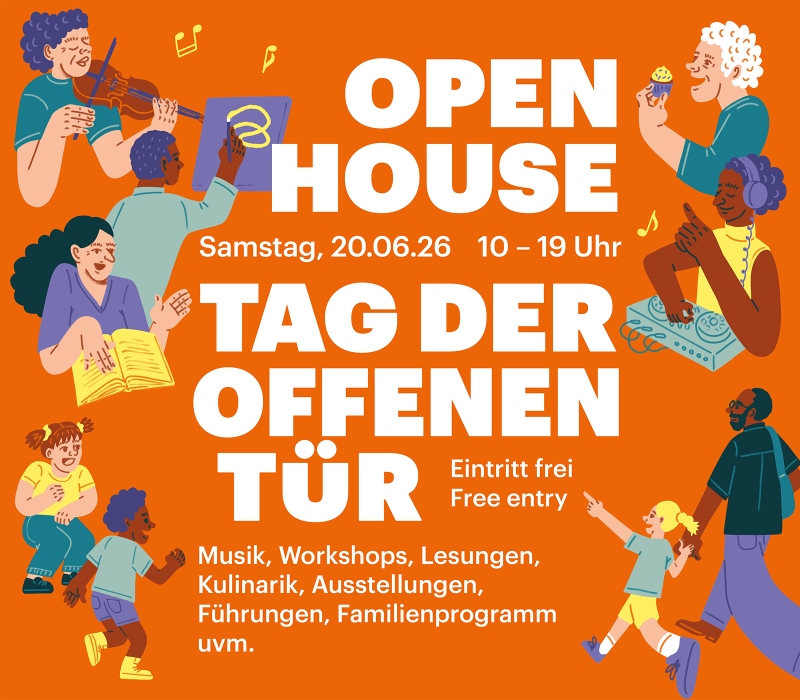
Come and join us! Annual Open Day at the Documentation Centre Displacement, Expulsion, Reconciliation
On 20 June, we’re opening our doors once again! On this year’s World Refugee Day and Day of Remembrance for Refugees and Expellees, we invite you to remember, connect, and get involved.
These days of remembrance honor the millions of people worldwide who are currently fleeing their homes, as well as those Germans who lost their home at the end of World War II. A day that encourages reflection, brings people together—and creates space for connection.
Look forward to a diverse program featuring creative workshops, live music, and inspiring conversations. We offer special activities for families, accompanied by culinary highlights. Authors will offer insights into their works, while our curators will guide you through the exhibitions and explain the background of displacement and expulsion.
A day full of experiences, encounters, and (hi)story—and the best part: Admission is FREE — we are looking forward to welcoming you.
FOR FAMILIES
A memory game for both young and grown-ups
10.00 a.m. – 7.00 p.m., Library, 1st Floor
Discover the illustrations of award-winning artist ‘Vikunia’ (aka Victoria Cichoń) in our latest memory game. Her characters are inspired by the stories and objects in our exhibition and depict snapshots of people experiencing displacement. You can also see them on the windows of the Documentation Centre. Come along and discover the lovingly designed pairs of pictures as you play together!
Quiz Tour with prize draw
10.00 a.m. – 6.00 p.m., Info Point in the Foyer, Ground Floor
Follow the clues and discover the stories of displacement and expulsion. In addition to exciting insights and a small surprise for completing the quiz tour sheet, you can win one of our prizes.
Prize drawings at 11 a.m. / 12.00 / 1.00 / 2.00 / 3.00 / 4.00 / 5.00 / 6.00 p.m.
Recommended age: 7 and up
Scavenger hunt: The Documentation Center for the Little Ones
10.00 a.m. – 6.00 p.m., Info Point in the Foyer, Ground Floor
Pick up a puzzle sheet and take it with you through the Documentation Center. Teddy has left you some tasks to complete on it. Have them read to you, find the matching items, and solve the puzzles. A little treasure awaits you at the end!
Recommended age: 3 and up
Face painting inspired by the world of Janosch
10.00 a.m. – 6.00 p.m., Exhibition, 1st Floor
The Tiger, the Tiger Duck and the Bear from the Janosch stories, originally from Upper Silesia, come to life during the face painting session. Come along and immerse yourself in the world of “Oh, How Beautiful Is Panama”!
With: Carola Maria Bremme
Story time for children with Ute Vossmerbäumer
10.00 – 10:30 a.m. (ages 3 and up)
2:30 – 3:00 p.m. (ages 7 and up)
Library, 1st floor
Surrounded by books, Ute Vossmerbäumer reads stories to children about leaving and arriving. Afterwards, there is time to browse and discover – for grown-ups too.
Sand animation, inspired by Otfried Preußler’s Das kleine Gespenst with Nadia Ischia
10.30 – 11.00 a.m. / 2.00 – 2.30 p.m., Event Hall, Ground Floor
Words and music guide the hands, while grains of sand bring images to life in real time. A poetic and evocative show inviting children and families to complete the forms with their imagination. Sand animation inspired by The Little Ghost by Otfried Preussler.
With: Nadia Ischia
Guided tours for children: What does it mean to leave your home?
10.30 – 11.00 a.m. / 2.00 – 2.30 p.m. / 4.30 – 5.00 p.m. (German)
Meeting point: 2nd floor
All over the world, people are fleeing their homes. Why do they have to flee? On this interactive tour, we will try to understand what it means to leave one’s home and start a new life in a foreign place.
Recommended age: 4 and up
Growing Together Through Dance and Music
12.30 – 1.15 p.m. with Karla L. Mendoza
3.30 – 4.15 p.m. with Johanna Aulikki Svensson
Event Hall, Ground Floor
The dancers take children aged three to twelve on a dynamic journey through themes such as friendship, solidarity, and courage. Through music and dance, a lively story emerges that brings people together and encourages participation. In the process, the children playfully discover how movement can build bridges between people.
In cooperation with: Music Family Hub: an initiative by Nanja Oedi & Pamela Bürger that advocates for better work-life balance.
READINGS, DISCUSSIONS & WORKSHOPS
Workshop: "Lost Traces…? The Basics of Family Research"
10.15 – 10.45 a.m. / 2.30 – 3.00 p.m., Library, 1st Floor
Where do you come from? Many people whose family history is marked by displacement or expulsion are still searching for their roots today, especially beyond the Oder and Neisse rivers in Eastern Europe. Here you will learn how such a search can lead to success.
In conversation: The Future of Remembrance of Displacement and Expulsion with Dr. Roland Borchers and Stephan Mayer
11.00 – 11.45 a.m., Library, 1st Floor
How is remembrance changing in Germany and Europe? Stephan Mayer, President of the Federation of Expellees, and Roland Borchers, Director of the Documentation Center, discuss remembrance and reconciliation — and what the history of German displacement and expulsion means for our present day.
Moderator: TBA
“Das Geschenk der leeren Hände – Annemarie Ackermann – eine Biografie” by Gudrun Hackenberg – Reading and Discussion
12.30 a.m. – 1.15 p.m., Library, 1st Floor
In an era dominated by men, Annemarie Ackermann became one of the first female members of the German Bundestag in 1953. Having herself fled from the Batschka, she advocated for displaced persons. The biography traces her journey and reflects on the core values of coexistence.
Moderator: Dr. Kathrin Jurkat, Documentation Center for Displacement, Expulsion, and Reconciliation
“Gefühlserben: Die geheime Macht und Kraft unserer Herkunft” by Sven Rohde – Reading and Discussion
1.30 – 2.15 p.m., Library, 1st. Floor
How do war, forced migration, and displacement affect us across generations? Sven Rohde explores the interplay between historical events, individual experiences, and transgenerational influences—and how these can also provide resources for personal development.
Moderator: Dr. Nils Köhler, Documentation Center for Displacement, Expulsion, and Reconciliation
“Reise nach Czernowitz” by Susanne Hanus – Reading and Discussion
4.00 – 4.45 p.m., Library, 1st. Floor
A grandmother, her son, and her granddaughter travel to Bukovina, from where the family was resettled in 1940. Following the trail of their family history, they travel to Görlitz, Seidenberg/Zawidow, and Czernowitz/Chernivtsi, documenting everything with diary entries and drawings.
Moderator: Anka Lück, Documentation Center for Displacement, Expulsion, and Reconciliation
The Genocide in Rwanda: Reading and Talk “Shut up and hide!” with Tete Loeper and Andreas Kirchhof (UNHCR)
5.00 – 5.45 p.m., Library, 1st. Floor
Rwanda 1994: As a child, Tete Loeper survived the genocide against the Tutsi. In a moderated reading, she discusses displacement, memory and reconciliation with Andreas Kirchhof, who worked for the UNHCR in the region at the time.
Moderator: Dr. Kathrin Jurkat, Documentation Center for Displacement, Expulsion, and Reconciliation
In cooperation with: UNHCR, the United Nations High Commissioner for Refugees
GET CREATIVE
Quiz Tour with prize draw
10.00 a.m. – 6.00 p.m., Info Point in the Foyer, Ground Floor
Follow the clues and discover the stories of displacement and expulsion. In addition to exciting insights and a small surprise for completing the quiz tour sheet, you can win one of our prizes.
Prize drawings at 11 a.m. / 12.00 / 1.00 / 2.00 / 3.00 / 4.00 / 5.00 / 6.00 p.m.
Recommended age: 7 and up
Scavenger hunt: The Documentation Center for the Little Ones
10.00 a.m. – 6.00 p.m., Info Point in the Foyer, Ground Floor
Pick up a puzzle sheet and take it with you through the Documentation Center. Teddy has left you some tasks to complete on it. Have them read to you, find the matching items, and solve the puzzles. A little treasure awaits you at the end!
Recommended age: 3 and up
Drop-In: Making a Statement – Designing Peace Doves
10.00 a.m. – 6.00 p.m., Gallery vor the library, 1st Floor
Make a creative statement for peace and design your own peace dove. Choose a colourful sheet of paper, follow the instructions, and craft your dove step by step.
Photo Box – for your souvenir snapshots
10.00 a.m. – 7.00 p.m., Workshop, 1st floor
Capture the best moment of the Open House in our photo booth and take the snapshot home as a souvenir - of course, free of charge!
Drop-In: What is Sütterlin? An Introduction with Gesa Füßle
10.30 a.m. – 12:30 p.m. / 1.00 – 3.00 p.m. / 3.30 – 5.30 p.m., Gallery, 1st Floor
Would you like to decipher your ancestors’ letters? Then dive into the world of times gone by. In our Sütterlin workshop, you’ll learn about the elegant cursive script once used by millions of Germans. Learn to decipher the old letters and practice writing them yourself.
With: Gesa Füßle
Drop-In: How to Draw Anything
11:00 a.m. – 1:00 p.m. / 1:30 – 3:30 p.m. / 4.00 – 6.00 p.m., Gallery, 1st Floor
Carlotta Klee will demonstrate how drawings emerge from simple shapes. Using chance techniques, you will create a ' cartography of chance ': a large map that fills up with your designs. Join in, become part of the growing collective artwork, and create your own keepsake to take home.
With: Carlotta Klee
GUIDED TOURS
Ask a Guide: Conveying the Experience of Displacement: The Stories Behind the Objects
10.00 – 11.00 a.m. / 1.00 – 2.00 p.m., 1st Floor
11 a.m. – 12.00 p.m. / 2.00 – 3.00 p.m., 2nd Floor
How do you convey the experiences of forced migration, loss, and new beginnings? Meet our guides in the permanent exhibition and learn the stories behind the objects. You can ask questions about the exhibition’s content, learn about our work as guides, or talk to us about your own story.
Ask the Curator: Behind the Scenes: How Do Objects End Up in the Museum?
11.00 a.m. – 1.00 p.m., in front of the main entrance
4.00 – 6.00 p.m., 2nd Floor, Exhibition
How do objects end up in the museum? What do a map, a child’s dress, or a key have to do with displacement and expulsion? Learn all about the objects in the Documentation Center and chat with our team.
OSTGEBIETE / ZIEMIE ZACHODNIE. German-Polish Perspectives (30 min)
11.00 – 11.30 a.m. / 1.00 – 1.30 p.m. / 3.00 – 3.30 p.m. / 5.00 – 5.30 p.m. (German)
12.00 – 12.30 p.m. / 2.00 – 2.30 p.m. / 4.00 – 4.30 p.m. / 6.00 – 6.30 p.m. (English)
Meeting point: Foyer, Ground Floor
The special exhibition invites you on a German-Polish journey of discovery. The guided tour presents photographic perspectives on memory, loss, and new beginnings. The different experiences of both countries come to light, offering new insights into a shared space of remembrance.
Displacement and Expulsion of Germans (30 min)
11.30 a.m. – 12.00 p.m. / 2.30 p.m. – 3.00 p.m. / 5.30 p.m. – 6.00 p.m. (German)
1.30 – 2.00 p.m. (English)
Meeting point: 2nd floor
Approximately 14 million Germans were affected by displacement and expulsion after World War II. The guided tour presents various biographies and objects that tell the stories of displacement and expulsion from Eastern, Central Eastern, and Southeastern Europe.
Displaced women and girls (30 min)
12.30 – 1.00 p.m. / 4.30 – 5.00 p.m. (German)
11.30 a.m. – 12.00 p.m. / 3.30 – 4.00 p.m. (English)
Meeting point: 1st Floor
More than half of all people who have had to flee or have been expelled are women and girls. The danger is great for all ages, and many become victims of sexual or sexualized violence. This guided tour focuses on rare personal accounts that recount such bitter experiences.
What happens when history meets modern architecture?
1.30 – 2.00 p.m. / 2.30 – 3.00 p.m.
Meeting point: in front of Room of Stillness
From the historic facade to modern exposed concrete: The architectural tour with Ticket B shows how history and the present converge at the Deutschlandhaus—an exciting look behind the scenes of the new documentation center.
In cooperation with: Ticket B Architecture Tours
Remembrance and Reconciliation after 1945 (30 min)
3.30 – 4.00 p.m. / 5.30 – 6.00 p.m. (German)
12.30 – 1.00 p.m. (English)
Meeting point: 2nd floor
Memories of displacement and expulsion following World War II are present in public spaces, in the media, and in family memories. Using individual objects and biographies, the tour presents the various forms of remembrance and initiatives for reconciliation in Europe.
Focus on the Yugoslav Wars (30 min)
4.00 – 4.30 p.m. (German)
5.00 – 5.30 p.m. (English)
Meeting point: 1st floor
The Yugoslav Wars of the 1990s led to severe acts of violence in Europe. Following the collapse of the state, nationalist tensions, forced migration, displacement, and so-called “ethnic cleansing” ensued, particularly in Bosnia and Herzegovina. The guided tour povides insights on the backgrounds and explores the experiences of refugees.
MUSIC & PERFORMANCE
Hassan Elmalik & SUN BLUES
11.00 – 11.30 a.m. / 1.00 – 1:30 p.m., Workshop, 1st Floor
Hassan Elmalik is from the heart of Sudan, where the Blue and White Nile meet and the blues was born. The oud virtuoso blends musical influences from different continents and eras, developing his own musical genre that bridges Africa, the Orient, and Europe, drawing on Sudanese tradition with avant-garde arrangements.
Genre: Blues music on the pentatonic scale of Sudan
Spotkanie / Encounter – Oliwia Meiser, cello · Yonatan Cohen, piano
11.30 a.m. – 12.00 p.m. / 1.30 p.m. – 2.00 p.m., Event Hall, Ground Floor
Cellist Oliwia Meiser and pianist Yonatan Cohen come together in a joint program featuring works by Schumann, Chopin, Tansman, and Szymanowski—music spanning Romanticism and Modernism, Poland and Germany, engaging in a dialogue with one another.
Genre: Classical Duo (Cello and Piano)
In cooperation with: Domröse & Schrader GbR
“Diaries in Motion” with Scenic Circus
12.00 – 12.30 a.m. / 3.00 – 3.30 p.m., Foyer, Ground Floor
Scenic Circus presents a 30-minute circus performance featuring excerpts from the shows “LYALKA” and “Diaries in Motion.” Three young artists from Ukraine and Russia combine juggling, acrobatics, and dance into a powerful, inspiring circus theater piece about self-determination, freedom, and community.
The music of SYRIAB moves between origin and future
2.30 – 3.00 p.m., Event Hall, Ground Floor / 4.30 – 5.00 p.m., Workshop, 1st Floor
The kanun, the Arabic zither, meets the oboe and clarinet—transcultural chamber music that celebrates diverse musical traditions. Baroque music blends with Arabic improvisation, Syrian songs, Sephardic melodies, and original compositions... a vibrant diversity à la SYRIAB.
When he fled Syria, Ibrahim Bajo (kanun) brought a rich musical heritage with him—together, the trio interprets the search for home, memory, and a new beginning.
Genre: Transcultural chamber music
Utopia: Ganna Gryniva & Laura Robles
5.00 – 5.45 p.m., Event Hall, Ground Floor
Immerse yourself in the music of Ganna Gryniva! On her album UTOPIA (2025), she blends Ukrainian folk music with jazz, indie pop, and electronic music. Drawing on archival research and original recordings, she collaborates with musician Laura Robles to create new soundscapes.
Genre: Ukrainian folk music with jazz, indie pop, and electronic music.
CULINARY DELIGHTS
Culinary Delights by Kreuzberger Himmel
10.00 a.m. – 7 p.m., Foyer, Ground Floor
Experience intercultural culinary delights by Kreuzberger Himmel. Refugees from various countries work here and serve up delicious specialties such as vegan kibbeh, lentil kebabs, and sanbousak. Back on the menu this year: Königsberger Klopse! A specialty from East Prussia, tender meatballs in a light caper sauce.
The culinary experience is accompanied by a selection of refreshing drinks.
Coffee Bike
10.00 a.m. – 7.00 p.m., Main Entrance on Stresemannstraße
Would you like to recharge your batteries between a guided tour and a concert? The Coffee Bike offers a wide selection of coffee specialties for a quick break!