


Dersim 1937/38: Testimonies of Survival
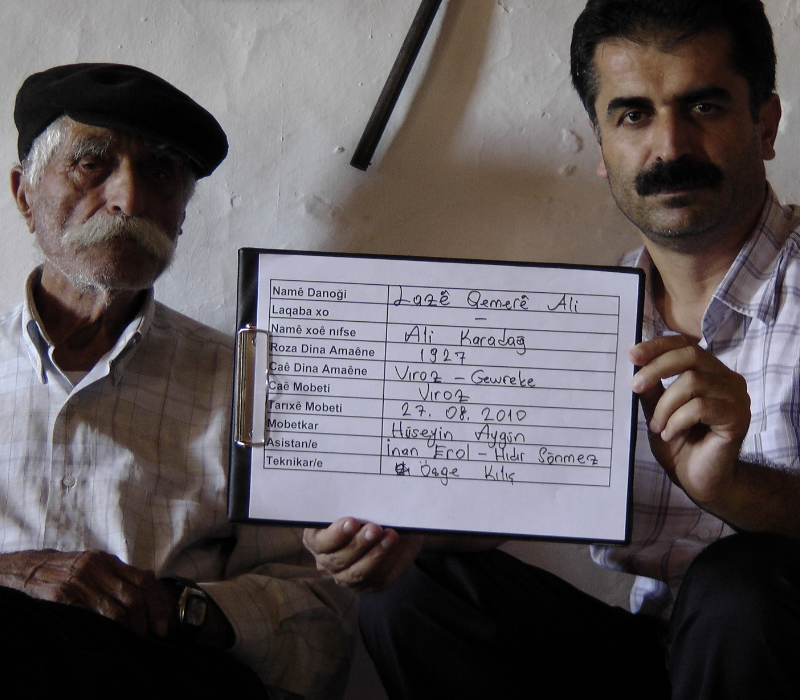
In 1937–38, Dersim in Eastern Anatolia became the scene of massacres perpetrated by the Turkish military against the predominantly Alevi population. Measures of expulsion and re-education contributed to the widespread destruction of Dersim’s traditional way of life. The project Dersim 1937/38 by the Dersim Culture and History Centre and Ruhr University Bochum has compiled interviews with eyewitnesses and is now presenting the videos, subtitled in Kırmancki, Turkish and German, to the public. In four panels, experts from the fields of violence research, linguistics, museology and art (film & graphic novel) will explore how the material can be used in the future. Join the discussion!
FURTHER INFORMATION
Admission: 12.30 pm
Language: German
FREE ADMISSION
REGISTRATION REQUIRED (Four panels are taking place simultaneously. We kindly ask you to register for one of the panels! You will find the registration links below in the programme overview.)
The event is a collaboration between the Dersim Culture and History Centre, Ruhr University Bochum and the Documentation Centre for Flight, Expulsion and Reconciliation.
PROGRAMME
1 p.m.
Welcome
Dr Kathrin Jurkat, Research Associate, Documentation Centre for Flight, Expulsion and Reconciliation
Opening panel Digital archives and the culture of remembrance
Ahmet Canpolat, Dersim Culture and History Centre
Prof. Dr Christian Gudehus, Social scientist, Ruhr University Bochum, Dersim 37/38 project
Dr Cord Pagenstecher, Research Fellow, Free University of Berlin, Oral-History.digital
Barbara Kurowska, Research Fellow, Documentation Centre for Flight, Expulsion and Reconciliation
Moderator: Dr Kathrin Jurkat, Research Fellow, Documentation Centre for Flight, Expulsion and Reconciliation
2:15 pm – 4 pm Using the Oral History Archive Dersim 1937/38
These panels will take place simultaneously. We would ask you to register for one of the four panels!
1st Panel: Education in Museums
What does it take to curate a well-researched historical exhibition and create an accompanying educational programme? Which materials can be combined in what ways to tell history and stories? And what role does the “Dersim 1937/38 Oral History Archive” play in this? Drawing on their many years of experience, the speakers will provide answers to these questions and discuss ways of presenting and communicating the history of Dersim in a museum setting.
Ruth Baumgartl, Education Officer, Documentation Centre for Flight, Expulsion and Reconciliation
Andreas Mix, Research Assistant for Exhibitions, Topography of Terror
Moderated by: Dr Kathrin Jurkat, Research Associate, Documentation Centre for Displacement, Expulsion, Reconciliation
2nd Panel: Linguistics
The majority of the eyewitness interviews are in Kirmanckî (Zazakî). From a linguistic perspective, the archive thus constitutes a metadata-rich corpus of spoken language, predominantly from older speakers. It is therefore useful for dialect research, morphophonological and grammatical analyses, and corpus construction, amongst other things. In this way, alongside historical reappraisal, the archive contributes to the documentation and research of an endangered language.
Mahîr Dogan, Linguist, University of Bamberg
3rd Panel: Violence and Space
Violence leaves its mark not only on bodies and biographies, but also on landscapes, language and public space. Forms of massive collective violence, such as the massacres in Dersim in 1937/38, do not belong solely to the past. Their effects continue to shape how spaces are inhabited, remembered and narrated to this day. The connection between violence and space is repeatedly evident in the interviews conducted as part of the Dersim 1937/38 project. The interviewees speak of the spaces that have been transformed by violence, and how their relationship to these spaces has also changed.
Dr Ismail Küpeli, Project Coordinator, Ruhr University Bochum, Dersim 1937/38 Project
Dr des. Tebessum Yılmaz, Lecturer, Humboldt University of Berlin
4th Panel: Film and Graphic Novels
Documentaries and feature films have long been established media for addressing historical events. For a good two decades now, graphic novels have also established themselves as a medium for conveying past and present events. In a dialogue between academia and the arts (with audience participation), we will explore how the experiences of the people of Dersim can be translated into these formats.
Gülseren Sengezer, journalist and film producer, Autorenkombinat GmbH
Bianca Schaalburg, author and illustrator
Dr Alexander Korb, Research Fellow, Arolsen Archives
Moderator: Prof. Dr Christian Gudehus, Ruhr University Bochum
16:30 Presentation and discussion of the findings
17:30 Closing